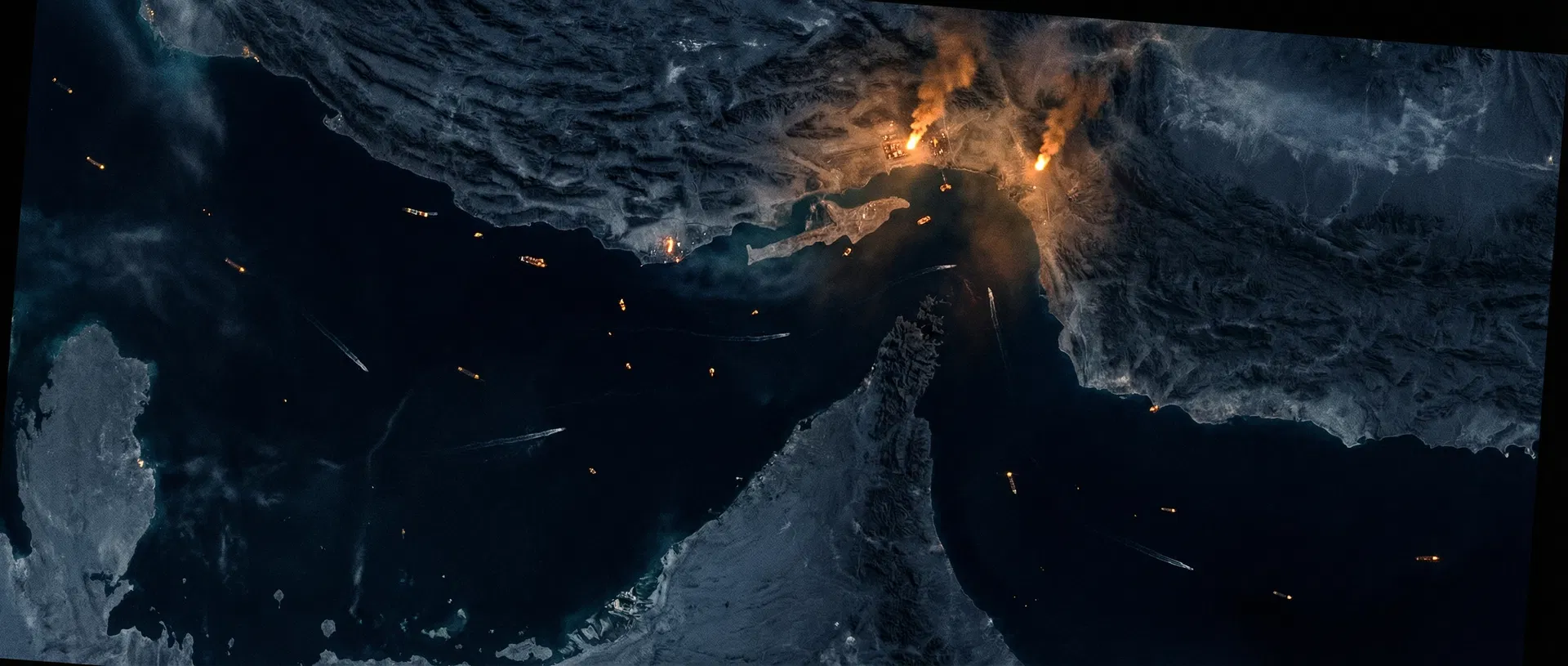
Strait of Hormuz Escalation
Impact Analysis for US Home Service Providers
Interactive scenario modeling of how the Iran-Hormuz crisis transmits through energy markets into the operating performance of HVAC, plumbing, electrical, and landscaping businesses across the United States.
Scenario Parameters
Moderate Scenario: 351 bps EBITDA Margin Compression
Under the moderate scenario (Brent at $81.2/bbl), a typical US home service provider faces 351 basis points of EBITDA margin compression over 6 months, with EBITDA declining from 14% to 10.49%. The dominant channel is direct cost pass-through (248 bps), driven by fleet fuel cost increases.
What does this mean in plain English?
NON-TECHNICALOil prices jump about 40% — that is like gas going from $3.50 a gallon to nearly $5.00. For a home service company running a fleet of trucks, this hits you directly in the wallet. Your profit margin drops from about 14% to roughly 10.49%, which means for every $100 you earn, you keep $10.49 instead of $14.
Filling up your service trucks costs about 30% more — that is roughly an extra $45 per truck over 6 months.
Parts and materials get more expensive too, because suppliers pass their higher shipping costs on to you.
Some homeowners start postponing non-urgent repairs (like upgrading their AC) to save money, so you may see fewer calls.
Your overall operating costs rise by about 2.88%, eating into your profits even if revenue stays flat.
Real-world analogy
Imagine your monthly fuel bill goes from $2,000 to $2,600 per truck — and that is just the direct hit. Your parts suppliers are also charging more, and a few customers are putting off that kitchen remodel.
What should you do?
Consider adding a temporary fuel surcharge of $5–15 per service call (many companies did this successfully in 2022), and lock in fuel contracts now before prices climb further.
Energy Price Projection — Brent Crude ($/bbl)
18-month forward path with confidence bands. Historical analogues shown as reference lines.
Transmission Channel Waterfall — Margin Impact (bps)
Decomposition of total EBITDA margin compression by channel. Each bar shows estimated impact and lag window.
KPI Impact Dashboard
Projected changes to key performance indicators under the selected scenario tier.
Sensitivity Analysis
Adjust shock magnitude and duration to see real-time KPI impact. Heat maps show the full parameter space.
Interactive Scenario Builder
Magnitude x Duration → EBITDA Impact (bps)
Each cell shows the projected EBITDA margin compression for a given oil price shock and disruption duration.
| Oil Δ | 3 mo | 6 mo | 12 mo | 18 mo |
|---|---|---|---|---|
| +20% | -36 | -47 | -61 | -72 |
| +30% | -54 | -70 | -92 | -108 |
| +40% | -72 | -94 | -122 | -144 |
| +50% | -90 | -117 | -153 | -180 |
| +60% | -108 | -140 | -184 | -216 |
| +70% | -126 | -164 | -214 | -252 |
| +80% | -144 | -187 | -245 | -288 |
| +90% | -178 | -232 | -303 | -356 |
| +100% | -216 | -281 | -367 | -432 |
| +110% | -257 | -335 | -438 | -515 |
| +120% | -302 | -393 | -514 | -605 |
Pass-Through Elasticity x Policy Lag → Revenue Impact (%)
Revenue impact varies with how much of the energy cost increase is passed through and how quickly policy intervenes.
| Elasticity | 0d lag | 30d lag | 60d lag | 90d lag | 120d lag |
|---|---|---|---|---|---|
| 0.3 | -1.35% | -1.53% | -1.71% | -1.89% | -2.07% |
| 0.4 | -1.80% | -2.04% | -2.28% | -2.52% | -2.76% |
| 0.5 | -2.25% | -2.55% | -2.85% | -3.15% | -3.45% |
| 0.6 | -2.70% | -3.06% | -3.42% | -3.78% | -4.14% |
| 0.7 | -3.15% | -3.57% | -3.99% | -4.41% | -4.83% |
| 0.8 | -3.60% | -4.08% | -4.56% | -5.04% | -5.52% |
| 0.9 | -4.05% | -4.59% | -5.13% | -5.67% | -6.21% |
Sub-Sector Vulnerability Comparison
Margin impact (bps) across service sub-sectors under the moderate scenario (+40% oil). Home Services highlighted.
- Direct Cost
- Supply Chain
- Demand
- Financial

Understand the Full Methodology
Explore the four-channel transmission model, scenario calibration, sensitivity framework, and complete assumptions register behind this analysis.